Claude Code with memory
Claude Code starts every session without remembering the last one. What applies in your project
— conventions, decisions, the pitfalls of an API — you explain again, or you maintain it by hand
in a CLAUDE.md. Osiris is a development environment for coding with Claude that
keeps this knowledge in one place and hands it to Claude by itself.
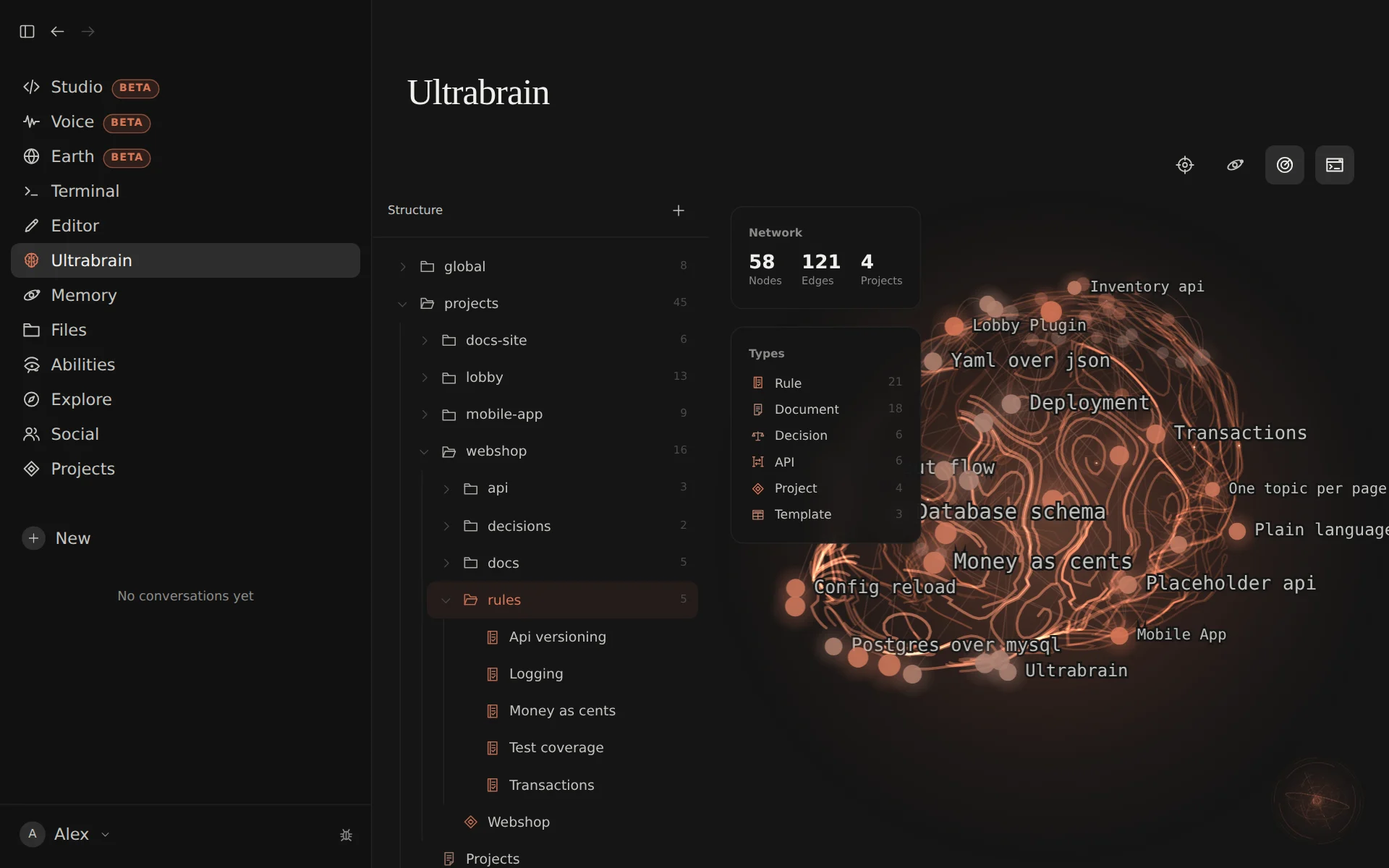
Ultrabrain: write it down once
At the core of Osiris is the brain — in the app, the Ultrabrain. Rules, notes and decisions live
in it as nodes: Markdown files with a short header, linked with
[[double square brackets]]. Every project gets its own branch with areas for rules,
API contracts, templates, decisions and docs; what applies everywhere sits above it.
- Rules like “never store money as a
float” — Claude reads them before the first decision that matters. - Priority and scope — a node can rank higher in the context or apply to every project at once.
- Notes and decisions — what you know about a project and why it is built the way it is.
Three ways Claude finds it
- The chat in Osiris. Osiris starts the Claude Code CLI itself and passes it the MCP configuration. Access to the brain is there from the first message, and the connected project applies automatically. What the chat shows besides: a GUI for Claude Code.
- CLAUDE.md sync. Osiris writes the rules that apply to a project into a marked block of its
CLAUDE.md; whatever you wrote around it stays. A short signpost in~/.claude/CLAUDE.mdtells Claude Code where the brain lives and which project is connected — even while Osiris is not running. - MCP server. For Claude Code in your own terminal and for the Claude desktop app: tools such as
ultrabrain_search,ultrabrain_read,ultrabrain_contextandultrabrain_writelet Claude look things up and record new findings;memory_queryandmemory_readopen the Memory.
The Memory: learning from conversations
Besides what applies, Osiris keeps what happened. After every conversation, a separate run condenses it into wiki pages — its schema asks every paragraph to name its source — following the pattern Andrej Karpathy called the LLM wiki. How that differs from RAG is explained under LLM wiki instead of RAG.
What goes to Claude — and what stays with you
Osiris talks to Claude through Anthropic's Claude Code, with your own access. What you write in
the chat goes to Anthropic, together with the rules and notes Osiris adds from the brain, the map
of the Memory with the pages Claude asks for, and files you attach. For every project, a context
preview shows its rules and notes as they go into the CLAUDE.md. Your projects, notes
and chats are stored on your computer. The Osiris server gets your sign-in, the licence check and,
when you open the app, the check for updates and maintenance — and otherwise only what you send on
purpose: Social messages, projects you publish in Explore, and feedback.
Markdown that stays yours
Because the files are the source of truth, Claude Code can also work in them directly; Osiris notices the change and updates the graph at once. Rename a node and Osiris carries the links pointing to it along. The brain stays a folder of Markdown — readable in Obsidian, versioned in Git, usable without Osiris. Osiris runs locally on Windows, macOS and Linux.